Medications Prescribed After a Car Accident: A Week-by-Week Guide for Case Managers
Amar Lunagaria, PharmD — Co-Founder & Chief Pharmacist, LienScripts | March 3, 2026 | Updated October 28, 2026 | 7 min read
Medications prescribed after a car accident depend on the injury: the prescriber often picks pain, muscle, nerve, sleep or mood medications. Here's what to expect and track.
Key Points
- The prescriber decides which medications a client gets. The office's job is to track what's prescribed and keep access on time.
- For each prescription, track the prescriber, start date, supply approvals, any change and its reason, and the pharmacy or delivery.
- Side effects, a medication not working, new specialists or a medication on back-order can all change prescriptions. Each change should have a documented reason.
- Through a medication agreement, the client pays $0 out of pocket, including delivery, and repayment comes from case proceeds and is non-recourse.
Amar Lunagaria, PharmD — Co-Founder & Chief Pharmacist, LienScripts
Medications prescribed after a car accident depend on the injury: the prescriber often picks pain, muscle, nerve, sleep or mood medications. Here's what to expect and track.
This guide is for PI case managers, paralegals and attorneys looking at a client's medication list after a crash. It covers which medication types usually show up, roughly when, and what the office should keep track of. The prescriber always decides what's right for the client.
Who decides which medications a client gets?
The prescriber does, based on the injury, history and other medications. The office's job is to track what's prescribed and keep access on time.
Every medication choice belongs to the client's prescriber: the emergency physician, primary care provider, specialist or psychiatrist. The law office doesn't choose medications. What the office can do is make sure every prescription reaches the pharmacy the client actually uses, that the next supply doesn't lapse, and that each change is documented.
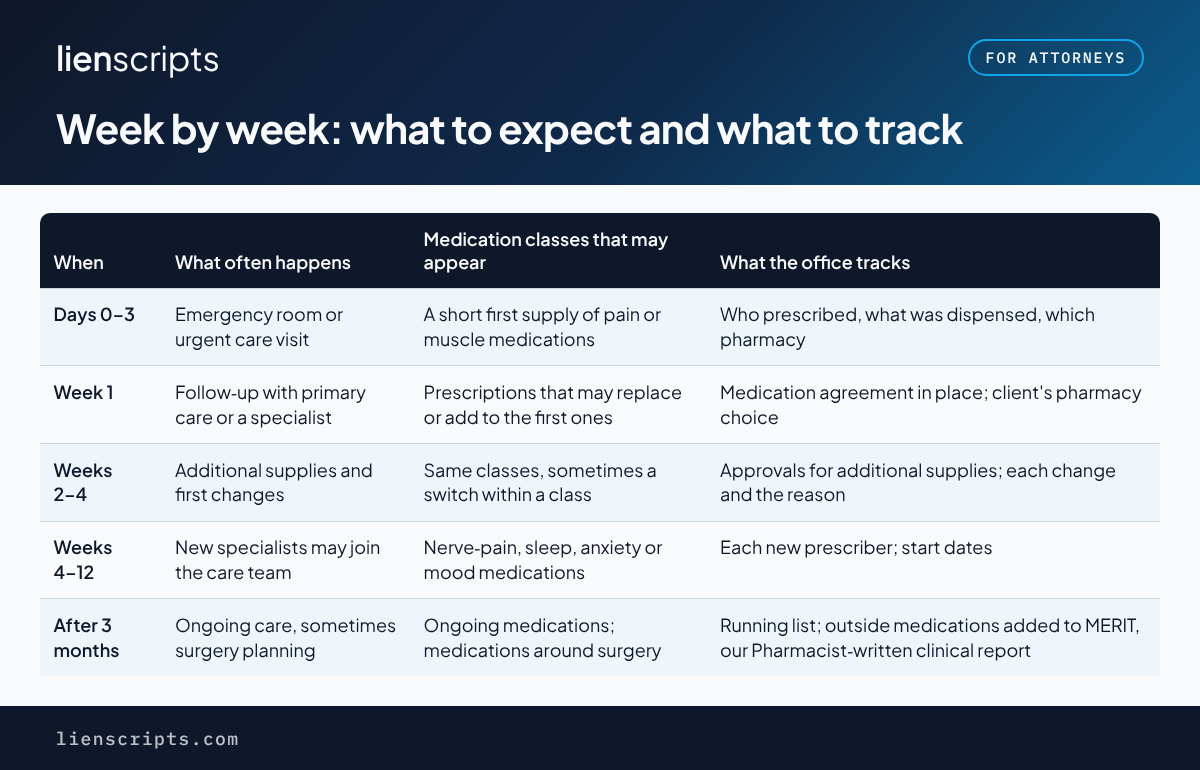
Medications prescribed after a car accident, week by week
Expect a short first supply, then follow-up prescriptions, additional supplies and new prescribers over the first three months. Track each change and why.
| When | What often happens | Medication classes that may appear | What the office tracks |
|---|---|---|---|
| Days 0–3 | Emergency room or urgent care visit | A short first supply of pain or muscle medications | Who prescribed, what was dispensed, which pharmacy |
| Week 1 | Follow-up with primary care or a specialist | Prescriptions that may replace or add to the first ones | Medication agreement in place; client's pharmacy choice |
| Weeks 2–4 | Additional supplies and first changes | Same classes, sometimes a switch within a class | Approvals for additional supplies; each change and the reason |
| Weeks 4–12 | New specialists may join the care team | Nerve-pain, sleep, anxiety or mood medications | Each new prescriber; start dates |
| After 3 months | Ongoing care, sometimes surgery planning | Ongoing medications; medications around surgery | Running list; outside medications added to MERIT, our Pharmacist-written clinical report |
Two legal points shape the first weeks. In Florida, a prescription for a Schedule II opioid for acute pain may not exceed a 3-day supply, or up to 7 days if the prescriber writes "ACUTE PAIN EXCEPTION" on it and documents why (Fla. Stat. § 456.44(5)(a)). Under federal law, a Schedule II prescription can't be used again for another supply (21 CFR 1306.12(a)), so each new supply needs a new prescription. Plan for follow-up prescriptions.
Neck and back injuries (including whiplash)
Prescribers often choose from anti-inflammatory, muscle relaxant and other pain medication classes. Which one, and for how long, is the prescriber's call.
For neck and back strain, prescribers commonly consider anti-inflammatory, muscle relaxant and other pain medication classes, sometimes with a topical medication. The specific medication, the amount and the length of treatment depend on the client and are decided by the prescriber.
Track: the prescriber, the start date, supply approvals, and any change and why.
Fractures and injuries that need surgery
Expect a short first supply of pain medication, possibly a follow-up prescription, and medications started around surgery.
Because of state supply limits and the federal rule that each new Schedule II supply needs a new prescription, a client with a fracture often needs more than one prescription in the first weeks. If surgery is scheduled, the surgeon's office decides which current medications to stop or keep and what will be prescribed after surgery. Ask a week before, so the prescriptions reach the client's pharmacy in time.
Track: the surgery date, the first supply, and when the follow-up prescription is due.
Nerve injuries and radiating pain
If pain radiates, burns or tingles, prescribers may add a nerve-pain medication class. That usually means a new start date and sometimes a new prescriber.
When a client describes pain that travels down an arm or leg, or burning or tingling, the prescriber may consider a nerve-pain medication class or a topical medication. These are often started after the first weeks, sometimes by a specialist.
Track: the new prescriber, the start date, and each change and why.
Head injuries and headaches
Headache and concussion care is often handled by a specialist, who decides on any medications. Expect a new prescriber.
After a head injury, the client may be referred to a specialist, who decides whether medications are needed and which ones. For the office, that usually means a new prescriber and a new pharmacy coordination step.
Track: the specialist prescriber, supply approvals, and where the client picks up.
Sleep, anxiety and mood after a crash
Sleep, anxiety and mood medications are common after a crash and are covered on the LienScripts formulary. LienScripts works with psychiatrists.
Clients often see a psychiatrist or their primary care provider for sleep, anxiety or mood after a crash. Sleep, anxiety and mood medications are covered on the LienScripts formulary, and LienScripts works with psychiatrists, so these prescriptions can run under the same medication agreement as the rest.
Track: the prescriber, the start date and supply approvals.
Why does the medication list keep changing?
Side effects, a medication not working, new specialists or a medication on back-order can all change prescriptions. Each change should have a documented reason.
A changing list is normal during a recovery. The common reasons:
- The prescriber adjusts treatment because of side effects or because a medication isn't helping enough.
- A new specialist joins and adds or replaces medications.
- A medication is back-ordered. A pharmacy can usually order a back-ordered medication in within a few days.
- A true shortage. Some medications are in nationwide shortage. The FDA Drug Shortages Database lists current shortages, and FDA advises talking with the health care provider or Pharmacist about other options when a drug is listed. The prescriber chooses any alternative.
Ask the prescriber's office for the reason behind each change and note it. MERIT explains why each medication was medically necessary.
What should a case manager track for each medication?
Prescriber, start date, supply approvals, changes and why, and where the client picks up.
- For each prescription: the prescriber, start date, supply approvals, any change and its reason, and the pharmacy or delivery.
- In your LienScripts account: status, records and every report in one place. LienScripts usually asks the case manager or attorney to approve each additional supply, unless the office says otherwise.
- MERIT: the clinical report on why each medication was medically necessary, written a few days after the client picks it up. Medications the client picked up outside the program can be added to it.
- For the demand: in Florida, the medication agreement and itemized, coded billing for § 768.0427 disclosures. In Texas, itemized charges for a § 18.001 affidavit, which supports reasonableness and necessity but not causation.
How do clients get these medications during the case?
Through a medication agreement: $0 out of pocket for the client, including delivery, repaid from case proceeds and non-recourse.
LienScripts is a pharmacy network for personal injury clients, run by Pharmacists, and a pharmacy deferred payment provider. The client signs a medication agreement, the legal representative also signs it, and the client picks up at their preferred local pharmacy or chooses delivery. The client pays $0 out of pocket, and repayment comes from case proceeds when the case resolves, completely non-recourse. Attorneys often call this a pharmacy lien: $0 out of pocket for the client, non-recourse. See what a pharmacy lien is and what a deferred payment provider is.
LienScripts covers many types of medications on its formulary, including some brand-name drugs and covered controlled medications. If the client paid out of pocket before the agreement was in place, LienScripts can sometimes apply those prescriptions retroactively, but the window is short, so call right away. If those prescriptions went through Medicaid (Medi-Cal in California) or Medicare, the window is shorter still.
For clients heading into surgery, see how LienScripts works with ambulatory surgery centers. Pharmacy access by state starts at the LienScripts locations page.
Frequently asked questions
What medications are commonly prescribed after a car accident?
Prescribers commonly choose from pain, anti-inflammatory, muscle relaxant, nerve-pain, topical, sleep, anxiety and mood medication classes, depending on the injury. The prescriber decides which medication, how much and for how long. The office's job is to track each prescription and keep access on time.
Why does my client's medication list keep changing?
Side effects, a medication not helping enough, a new specialist, a back-order or a shortage can all change prescriptions. Under federal law, each new supply of a Schedule II medication also needs a new prescription. Ask for the reason behind each change and note it.
Can a client get sleep, anxiety or mood medications during the case?
Yes. Sleep, anxiety and mood medications are covered on the LienScripts formulary, and LienScripts works with psychiatrists. The client pays $0 out of pocket, and repayment from case proceeds is non-recourse.
What should we track for each prescription?
The prescriber, start date, supply approvals, any change and the reason for it, and where the client picks up. Your LienScripts account shows status, records and reports in one place.
What does the client pay for these medications?
Nothing out of pocket. With a LienScripts medication agreement, the client pays $0 out of pocket at the pharmacy and for delivery. Repayment comes from case proceeds when the case resolves, and it is completely non-recourse.
Refer a client who needs prescriptions at lienscripts.com/refer.
Questions? Call or text (415) 287-2367, or email support@lienscripts.com.
Frequently Asked Questions
What medications are commonly prescribed after a car accident?
Prescribers commonly choose from pain, anti-inflammatory, muscle relaxant, nerve-pain, topical, sleep, anxiety and mood medication classes, depending on the injury. The prescriber decides which medication, how much and for how long. The office's job is to track each prescription and keep access on time.
Why does my client's medication list keep changing?
Side effects, a medication not helping enough, a new specialist, a back-order or a shortage can all change prescriptions. Under federal law, each new supply of a Schedule II medication also needs a new prescription. Ask for the reason behind each change and note it.
Can a client get sleep, anxiety or mood medications during the case?
Yes. Sleep, anxiety and mood medications are covered on the LienScripts formulary, and LienScripts works with psychiatrists. The client pays $0 out of pocket, and repayment from case proceeds is non-recourse.
What should we track for each prescription?
The prescriber, start date, supply approvals, any change and the reason for it, and where the client picks up. Your LienScripts account shows status, records and reports in one place.
What does the client pay for these medications?
Nothing out of pocket. With a LienScripts medication agreement, the client pays $0 out of pocket at the pharmacy and for delivery. Repayment comes from case proceeds when the case resolves, and it is completely non-recourse.