How to Request Pharmacy Records for a Personal Injury Case (Florida and Texas)
James Wong, PharmD — Founder & Pharmacist, LienScripts | November 2, 2026 | 11 min read
A complete request pairs the prescription history and charge records with a HIPAA authorization, and Florida and Texas each set their own rules for the charges.
Key Points
- A complete request covers the dispensing history, the itemized billing with payments and balances, and any agreement your client signed for payment.
- Clients have a right to their own pharmacy records. A law office needs the client's signed HIPAA authorization, or a subpoena with notice to the client.
- Florida's § 768.0427 treats a medication agreement as an LOP, so you must disclose it with the coded billing before pharmacy charges can be claimed.
- Texas charges usually come in through a § 18.001 affidavit, which is due 90 days after the defendant answers or by the expert-designation deadline, whichever comes first.
Pharmacy records can make or break the medication side of a demand, so it's worth getting the request right the first time. You'll want the dispensing history, the itemized billing, and a signed HIPAA authorization to send with your request. If your client received prescriptions under an LOP or a medication agreement in Florida, § 768.0427 requires you to disclose that agreement along with the coded billing. Texas works differently, and there the charges typically reach the jury through a sworn § 18.001 affidavit.
The rest comes down to getting the right documents from the right person, then meeting your state's rules before a jury sees the charges. If you'd rather start from a letter, there's one near the end you can copy and adapt.
What counts as "pharmacy records" in a PI case?
When you ask a pharmacy for "records," you're really asking for three things, and a request that misses any one of them usually means a second request later.
The first is the dispensing history, which some pharmacies call the prescription profile. It lists every prescription the pharmacy dispensed to your client. For each prescription, the history lists the date, the medication name, the National Drug Code (NDC), the quantity, the days' supply, and the prescriber. It also shows whether that prescription was new or another supply on an existing one. Think of it as the timeline of your client's care.
The second is the itemized billing, sometimes called the charge ledger. It shows what the pharmacy charged for each prescription, what was paid and by whom, and what is still owed. Please don't skip it. Florida and Texas both turn on these numbers, so a dispensing profile without the charges won't carry the damages side of your case.
The third is the payment agreement. If your client received prescriptions under an LOP or a medication agreement, ask for a copy of that document, because Florida requires it to be disclosed.
Along with those three, you'll want a custodian affidavit or certification. That's the sworn statement that lets the documents in without bringing a live custodian to court, and Florida and Texas each have their own form.
Pharmacies may keep more than that, and it can be worth asking for. You can request Pharmacist notes, drug-interaction alerts and how they were resolved, prior authorization history, insurance rejections, counseling notes, and transfers between pharmacies. Not every pharmacy keeps all of these, and retention times vary, which is one more reason to send your request early.
Who can get a client's pharmacy records?
Your client can always get their own records. Everyone else, including your office, has to work through the client's written HIPAA authorization or a subpoena served with notice to the client.
When the client asks for their own records, 45 CFR 164.524 gives the pharmacy 30 days to act. The pharmacy can take one extension of up to 30 more days, but only if it gives the client a written statement of the reasons and a date when it will finish. It may charge only a reasonable, cost-based fee for copies.
If you'd rather receive the documents directly, that's what the HIPAA authorization is for. Under 45 CFR 164.508(c), the authorization has to describe the information specifically and name who may disclose it and who may receive it. It also has to state the purpose, although "at the request of the individual" is enough when the client starts the request. It needs an expiration date or event, along with the client's signature and the date. It also has to tell your client three things: they can revoke it, whether treatment can be conditioned on signing, and that once the recipient rediscloses the information, it's no longer protected (45 CFR 164.508(c)(2)).
If you don't have an authorization or a court order, a subpoena can still work, but the pharmacy may respond only with satisfactory assurance that the client was given notice and a chance to object, or that a qualified protective order has been sought (45 CFR 164.512(e)).
Florida adds its own layer. Fla. Stat. § 465.017(3) limits pharmacy dispensing records to the patient, the patient's legal representative, or someone holding the patient's written authorization. In a civil case, a pharmacy may furnish them on a court subpoena with proper notice to the patient (§ 465.017(3)(a)).
Florida: what § 768.0427 requires for pharmacy charges
Florida's rule is the one that catches people off guard, because it treats pharmacies like any other provider. The statute's list of providers includes "a pharmacy permitted under chapter 465" (Fla. Stat. § 768.0427(1)(c)9.), and its definition of a letter of protection covers any arrangement to treat in exchange for payment from the recovery, "regardless of whether referred to as a letter of protection" (§ 768.0427(1)(d)). In practice, that means a medication agreement is an LOP for disclosure purposes.
Before your client can claim those expenses, the statute requires several disclosures (§ 768.0427(3)). You'll need to produce a copy of the LOP and the itemized, coded billing. You'll also need to say whether the receivable was sold to a factoring company and for how much, what health coverage your client had at the time, and whether your client was referred for treatment and by whom.
The statute also shapes what the jury hears about unpaid charges. If the client was insured and treated under an LOP, the evidence includes what the client's coverage would have paid. If the client was uninsured, or on Medicare or Medicaid, the evidence is 120% of the Medicare rate, or 170% of the Medicaid rate where there's no Medicare rate (§ 768.0427(2)(b)2.–3.).
You don't need a live custodian to get the records in. Business records come in under § 90.803(6) with a custodian's certification or declaration under § 90.902(11). If you offer them that way, you must serve reasonable written notice and make the documents available for inspection early enough to give the other side a fair chance to challenge them (§ 90.803(6)(c)).
For more on the Florida side, see Florida pharmacy lien laws explained. If your client is in Florida, visit the LienScripts Florida hub.
Texas: the § 18.001 affidavit for pharmacy charges
In Texas, a sworn affidavit with itemized charges does most of the work, as long as nobody serves a controverting affidavit in time. Under Tex. Civ. Prac. & Rem. Code § 18.001(b), an uncontroverted affidavit is sufficient evidence that a charge was reasonable or a service necessary. It is not evidence of causation, so you'll still need to prove that separately.
The affidavit has to come from the provider or the person in charge of its records, it has to be sworn, and it has to include an itemized statement of each service and charge (§ 18.001(c)). The form in § 18.002(b-1) also asks for the total amount paid and the amount still unpaid that the provider has a right to be paid after adjustments or credits.
Timing is where cases slip. You have to serve the affidavit by the earlier of 90 days after the defendant answers or the offering party's expert-designation deadline (§ 18.001(d)). For a provider who first treats after the answer, the deadline is the expert-designation date (§ 18.001(d-1)). When you serve it, give the clerk notice that it was served (§ 18.001(d-2)).
If the other side wants to fight the charges, it serves a sworn controverting affidavit of its own, generally due 120 days after the answer or by its expert-designation deadline, whichever comes first (§ 18.001(e)). If care continues past a deadline, you can supplement the affidavit up to the 60th day before trial (§ 18.001(h)). The parties can also change these deadlines by agreement or with leave of court (§ 18.001(i)).
The amount matters as much as the paperwork. Under § 41.0105, recovery of medical expenses "is limited to the amount actually paid or incurred by or on behalf of the claimant." In Haygood v. De Escabedo, 356 S.W.3d 390 (Tex. 2011), the Texas Supreme Court held that this limits both recovery and the evidence at trial to expenses the provider has a legal right to be paid.
To authenticate the records themselves, Tex. R. Evid. 902(10) makes a business record with a compliant custodian affidavit self-authenticating, as long as the record and affidavit are served on each other party at least 14 days before trial. For medical-expense affidavits, the rule's comment points you back to §§ 18.001 and 18.002 through its "any other requirements of law" language, so you'll want both in order.
If your client is in Texas, visit the LienScripts Texas hub.
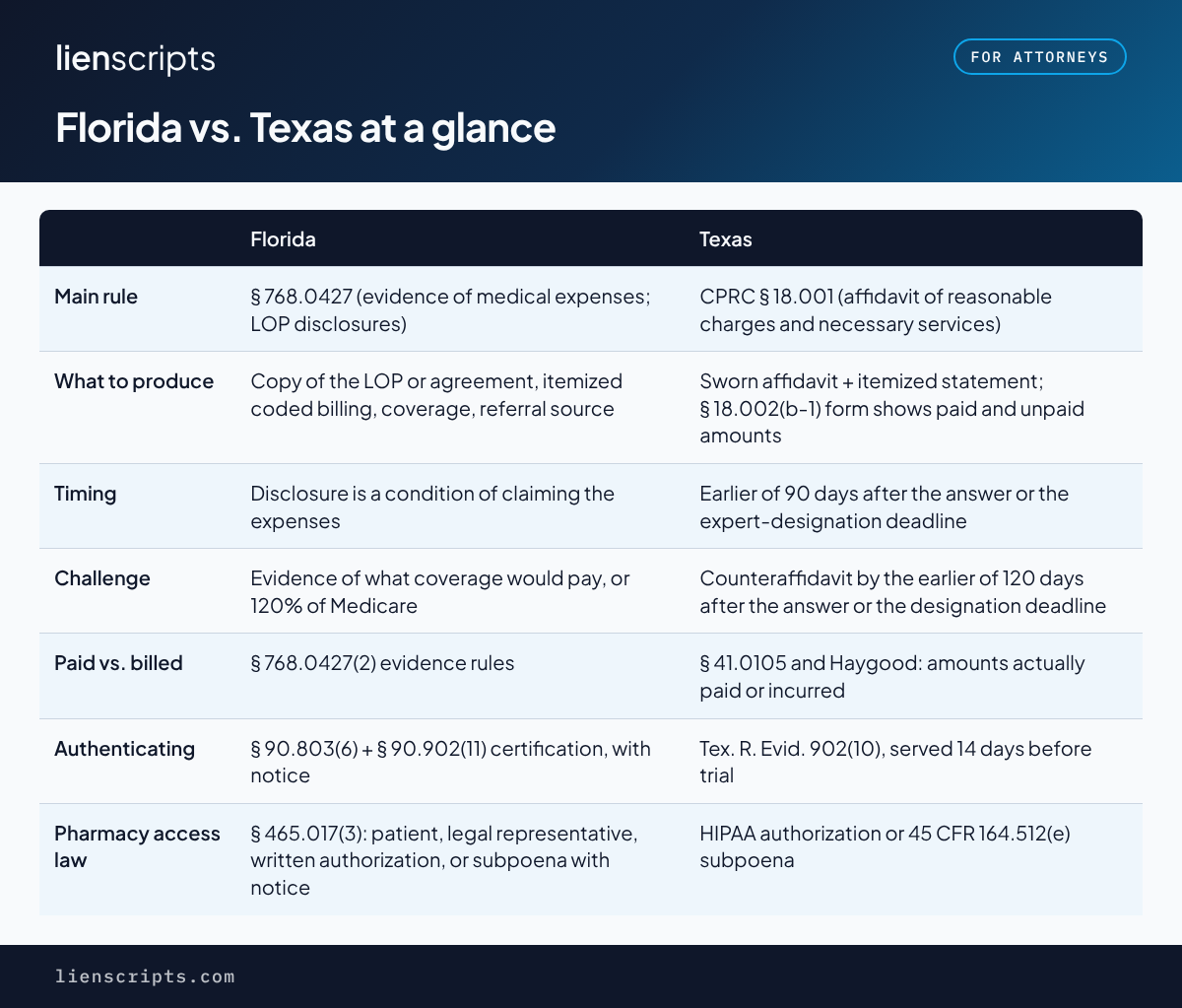
Florida vs. Texas at a glance
Florida mostly turns on disclosing the payment agreement and the coded billing, while Texas turns on serving a § 18.001 affidavit on time with the paid and unpaid amounts. Here's how the two compare side by side.
| Florida | Texas | |
|---|---|---|
| Main rule | § 768.0427 (evidence of medical expenses; LOP disclosures) | CPRC § 18.001 (affidavit of reasonable charges and necessary services) |
| What to produce | Copy of the LOP or agreement, itemized coded billing, coverage, referral source | Sworn affidavit + itemized statement; § 18.002(b-1) form shows paid and unpaid amounts |
| Timing | Disclosure is a condition of claiming the expenses | Earlier of 90 days after the answer or the expert-designation deadline |
| Challenge | Evidence of what coverage would pay, or 120% of Medicare | Controverting affidavit by the earlier of 120 days after the answer or the designation deadline |
| Paid vs. billed | § 768.0427(2) evidence rules | § 41.0105 and Haygood: amounts actually paid or incurred |
| Authenticating | § 90.803(6) + § 90.902(11) certification, with notice | Tex. R. Evid. 902(10), served 14 days before trial |
| Pharmacy access law | § 465.017(3): patient, legal representative, written authorization, or subpoena with notice | HIPAA authorization or 45 CFR 164.512(e) subpoena |
A pharmacy records request template
A good request names the pharmacy and the client, includes the signed HIPAA authorization, and spells out exactly what you need. You're welcome to copy the letter below and adapt it, but please have the attorney check it against your court's rules and any subpoena requirements first.
[Law office letterhead]
[Date]
[Pharmacy name, store number and address] Attn: Pharmacy Records Custodian
Re: Request for pharmacy records — [Client full name], DOB [date]
Enclosed is a HIPAA authorization signed by [client name] under 45 CFR 164.508. Please provide the following for [date of injury] to the present:
- The complete dispensing history: date, medication, NDC, quantity, days' supply, prescriber, and whether it was a new prescription or another supply.
- Itemized billing for each prescription: charge, amounts paid and by whom, adjustments or credits, and any balance still owed.
- Prescriptions received but not dispensed, with the reason.
- Pharmacist notes and drug-interaction alerts, and how each was resolved.
- Prior authorization history: dates submitted, denied, appealed and resolved.
- Insurance claim rejections, with rejection codes.
- Counseling documentation.
- Transfers to or from other pharmacies.
- The client's documented allergies and medication sensitivities.
- [Florida] A custodian certification or declaration under Fla. Stat. § 90.902(11). [Texas] An affidavit under Tex. Civ. Prac. & Rem. Code § 18.001, substantially in the form of § 18.002(b-1), and a business records affidavit under Tex. R. Evid. 902(10).
Electronic copies are fine. If there is a fee, please send a cost estimate first. Please also keep these documents for the life of the case.
[Name, title, phone, email]
Getting pharmacy records from LienScripts
If your client gets prescriptions through LienScripts, you don't have to send a separate request to each pharmacy for those prescriptions. Your LienScripts account shows status, records and every report in one place. Itemized billing is in the account too, or you can request documents at billing@lienscripts.com, whether you need it for Florida § 768.0427 disclosures or a Texas § 18.001 affidavit. You'll also find the medication agreement, which the client and the legal representative both signed.
We also provide MERIT, our Pharmacist-written clinical report, which explains why each medication was medically necessary. A Pharmacist writes it a few days after the client picks up the medication, and medications the client picked up outside the program can be added to it.
With a pharmacy lien through LienScripts, your client pays $0 out of pocket, including delivery, and repayment comes from case proceeds and is non-recourse. To learn more, see what a pharmacy lien is and what a deferred payment provider is.
Common mistakes when requesting pharmacy records
The mistake we see most often is an authorization that names the wrong pharmacy. Make sure it names the pharmacy and the store your client actually used, and ask whether the chain handles document requests centrally, because some chains route them through one office.
The second is asking for the profile without the charges. A medication list without charges, payments and balances won't support a Texas § 18.001 affidavit or Florida's paid-versus-unpaid evidence rules.
In Texas, people also miss the service window. The 90-day clock starts when the defendant answers, not when you're ready to send a demand. In Florida, the agreement sometimes gets left out of the disclosures, even though a medication agreement is a pay-from-recovery arrangement under § 768.0427(1)(d).
Finally, watch the dates. Check the authorization's expiration date or event before you send a follow-up request. Ask early, too, because how long pharmacies keep notes and alerts varies, and it helps to ask the pharmacy to keep them for the life of the case.
Frequently asked questions
Can a case manager request a client's pharmacy records directly?
Yes, you can, as long as you have the client's signed HIPAA authorization that meets 45 CFR 164.508(c). Without one, the pharmacy needs a court order or a subpoena with satisfactory assurance that the client got notice. In Florida, § 465.017(3) also limits pharmacy dispensing records to the patient, the legal representative, someone with written authorization, or a court subpoena with notice.
How long does a pharmacy have to send records?
When the client asks for their own records, HIPAA gives the pharmacy 30 days to act, with one extension of up to 30 more days if it explains the delay in writing (45 CFR 164.524). A request from a law office under an authorization doesn't have the same deadline, so it pays to ask early and follow up.
If you have a client who needs prescriptions, you can refer them at lienscripts.com/refer.
Questions? Call or text (415) 287-2367, or email support@lienscripts.com.
Frequently Asked Questions
Can a case manager request a client's pharmacy records directly?
Yes, you can, as long as you have the client's signed HIPAA authorization that meets 45 CFR 164.508(c). Without one, the pharmacy needs a court order or a subpoena with satisfactory assurance that the client got notice. In Florida, § 465.017(3) also limits pharmacy dispensing records to the patient, the legal representative, someone with written authorization, or a court subpoena with notice.
How long does a pharmacy have to send records?
When the client asks for their own records, HIPAA gives the pharmacy 30 days to act, with one extension of up to 30 more days if it explains the delay in writing (45 CFR 164.524). A request from a law office under an authorization doesn't have the same deadline, so it pays to ask early and follow up.